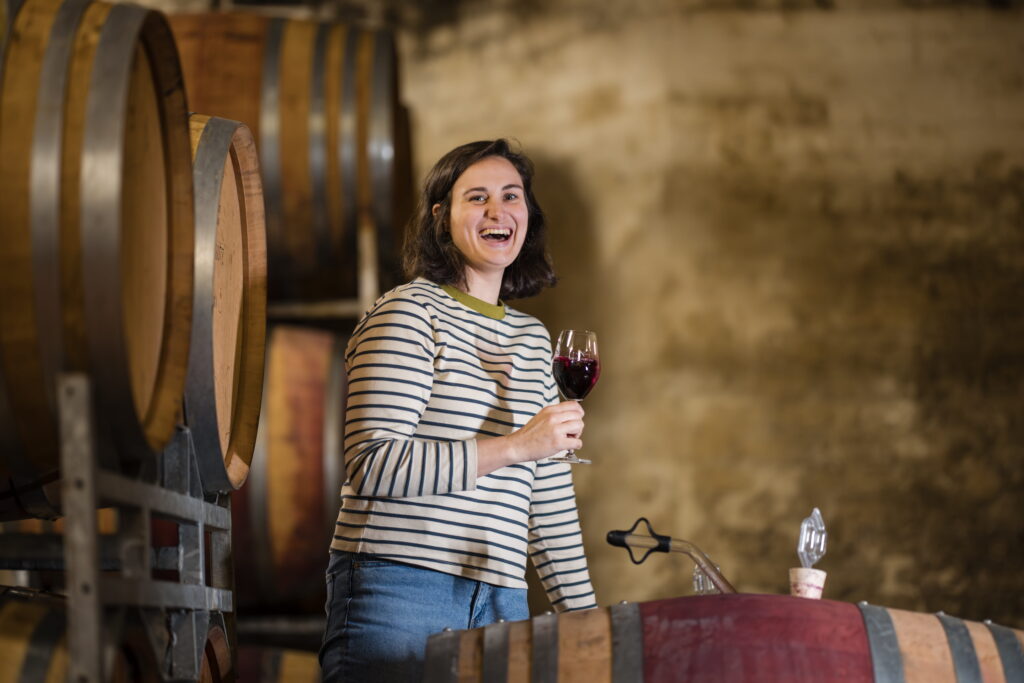
Starting a new chapter at Cederberg Wines, we introduce newest member of our winemaking team Mika Engelbrecht. Mika brings with her a passion for terroir, a spirit of curiosity, and experience gained across some of the world’s most respected wine regions. From growing up surrounded by vineyards in the Western Cape to refining her craft in South Africa, Austria and France, her journey has been shaped by a love of nature, continuous learning, and a commitment to producing wines that truly reflect their origin.
We sat down with her to learn more about what inspired her to become a winemaker, the lessons she’s bringing to Cederberg, and what excites her most about crafting wines in one of South Africa’s most unique high-altitude vineyards.
1. What drew you to Cederberg Wines?
It’s a mix of everything! It’s an amazing new opportunity with fresh challenges, a chance to work with a fantastic new team, and honestly, the terroir and exceptional vineyards are a winemaker’s dream to work with.
2. When did you first become interested in becoming a winemaker?
To some extent, winemaking chose me. Growing up, my family had a smallholding in Tesselaarsdal, and every weekend we’d drive through the Hemel-en-Aarde valley. I found myself completely captivated by the vineyards lining the route, and those weekends on the farm really sparked my deep passion for nature and the outdoors.
When it came time to make the big ‘future decisions’ before university, I was wandering around the Stellenbosch University AgriSciences Open Day. Like a true stubborn teenager, I rarely listened to my mother, but when she gestured toward the oenology stand and asked, ‘What about that?’ something clicked. I went home and fell down an internet research rabbit hole. Seeing how winemaking blended passion, creativity, a deep connection to nature, and the dynamic, seasonal lifestyle (completely far removed from a standard nine-to-five) I knew there couldn’t be anything else for me.
3. How has your international experience influenced your approach?
My approach is guided by the belief that you are never too old to learn. In this industry, you must be like a sponge-soaking up all the information, history, and collective knowledge around you, and then refining it through thoughtful trial and error.
Wine is a living, evolving thing; it’s not something you can just ‘copy and paste’ from one place to another. Every vineyard and every vintage demands that you adapt to the land you are standing on. My goal is to bring that exact blend of deep curiosity, bold experimentation, and precise intuition to Cederberg, letting this incredible mountain terroir truly speak for itself.
4. What are you most excited about in your new role?
I am incredibly excited to collaborate with a driven, like-minded team that consistently pushes the boundaries of excellence, while having the privilege of absorbing a wealth of world-class winemaking expertise, visionary leadership, and profound passion directly under the guidance of a master of the craft like David Nieuwoudt.
5. What are the fundamentals of your winemaking approach?
When crafting wines, I strive to capture the essence of the local terroir. I believe that a great wine should not only be delicious but also reflect the unique characteristics of the grapes and the land from which they come. By understanding the nuances of the different soils, climates, and microclimates within the region, I can create wines that are truly representative of their origin. My goal is to produce wines that are elegant, balanced, and expressive of the terroir. I believe that by respecting the land and the grapes, we can create wines that are not only enjoyable but also sustainable.
6. You’ve worked in South Africa, Austria, and France. What’s one lesson from each country that you’ll bring to Cederberg?
South Africa – Innovation and Resilience
Having worked in South Africa before, the lesson I return with is one of fearless innovation and resilience. Our wine industry isn’t afraid to push boundaries, experiment with new techniques, and challenge old-world norms. I bring that spirit of bold creativity to Cederberg, combining it with European precision to see just how far we can elevate high-altitude winemaking.
Austria – Terroir and Altitude
Austria taught me how to respect the extremes. Working in its cool-climate regions, I learned how terroir and altitude dictate the entire lifecycle of the vine. At high altitudes, you get intense solar radiation paired with cool nights, which preserves a wine’s pristine acidity and sharpens its aromatic profile. Bringing that exact focus to Cederberg—one of South Africa’s highest wine regions—allows me to precisely channel the mountain’s unique microclimate into exceptionally crisp, expressive wines.
France – Tradition and Precision
From France, the greatest takeaway was a deep reverence for heritage and structural precision. The French approach to winemaking is an exercise in patience and letting the vineyard speak for itself with minimal intervention. It taught me the art of crafting wines with longevity, balance, and elegance, ensuring that every bottle tells a clear story of the earth it came from.
7. What is your most memorable wine or wine-tasting experience?
What immediately comes to mind is an experience during a summer exchange program in South Australia when we visited the d’Arenberg Cube in McLaren Vale. Resembling a giant, floating Rubik’s Cube dropped into a vineyard, this five-story wine and art center offers an indulgent, artistic and informative journey into the depths of d’Arenberg’s viticulture and winemaking—complete with immersive galleries and a Salvador Dalí exhibition. The absolute highlight was heading up to the panoramic top-floor tasting room, where I enjoyed a refreshing glass of wine surrounded by stunning, 360-degree views of the rolling hills.
8. What are your personal winemaking goals?
My personal winemaking goals center around continuous growth. I want to keep learning from every vintage, evolving my craft, and ultimately making lekker wines that showcase the incredible terroir I’m working with. It’s about pairing a dedication to constant improvement with the simple joy of making wines that bring people together.
9. What is your favourite food and wine pairing?
Without a doubt, it has to be a slow-cooked oxtail paired with a rich Cabernet Sauvignon.
Share This Article: